
Key Takeaway
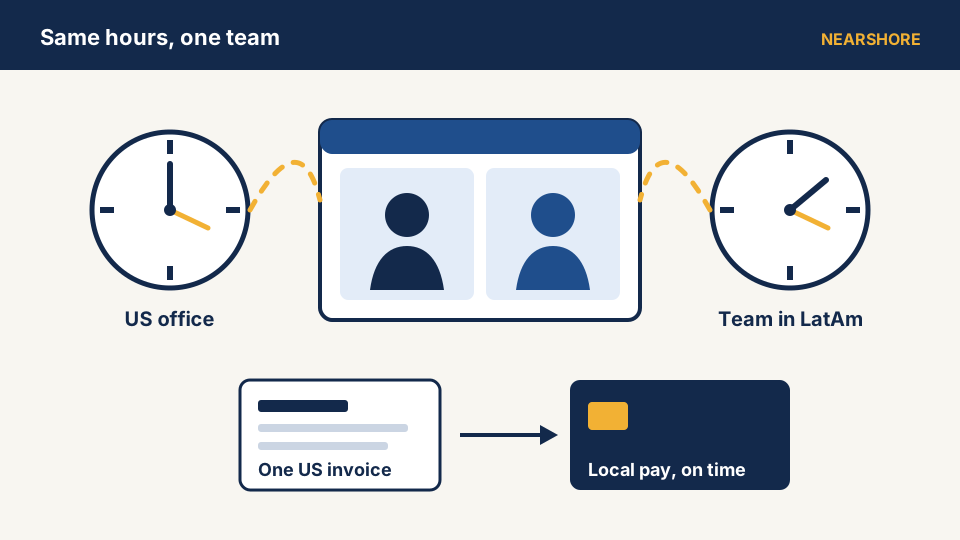
- Our nearshore hiring service recruits staff in Latin America who work during US business hours.
- You pay one US invoice, and each payment abroad follows local law.
- Where a local employer is required, our employer of record partner holds the contract.
Our nearshore hiring service helps US companies build teams in Latin America that work the same hours as their staff. First, we write the role brief with you, and then we find candidates and test their English and their skills. Once you choose a hire, you pay one US invoice each month, and we coordinate the pay for your people. In countries where cross-border pay is hard, licensed local partners make the payment under the local rules of that country. As a result, you get people who join your morning calls, plus a clear record for each payment you make.
Why Do US Firms Struggle to Hire and Pay Staff Abroad?
Many US firms find it hard to fill roles at home at a cost they can sustain. As a result, they look abroad, often to Asia or Eastern Europe. However, a gap of ten hours makes daily teamwork slow for remote staff.
Nearshore hiring in Latin America solves the time zone problem, but it brings a new one. Indeed, paying people there can be complex. For example, some countries limit how money moves in and out, and some banks hold transfers for days.
In other places, nearshore staff must issue a local invoice for each payment. Meanwhile, currency swings can change what a salary is worth from one month to the next. Consequently, many firms give up on nearshore hiring after the first payroll goes wrong.
We built this service to remove that friction. Thus, you keep the time zone benefit, and we coordinate the pay. Above all, every step is planned around the law of the country where your people live.
What Does Nearshore Mean for a Team Based in the US?
In nearshore hiring, your staff live in a nearby time zone, not just in a nearby country. Most of Latin America is located one to three hours from US Eastern Time. Therefore, your nearshore team can join a morning call in New York or Chicago.
That overlap changes how nearshore teams work. For example, questions are answered the same day, and reviews happen in real time. In addition, people can join the same planning calls and the same chat threads as your US staff.
Language matters as much as time. Accordingly, every candidate we send has passed an English screen that fits the role. For instance, a sales role needs fluent speech, while a back-office role may need strong written English.
How Do We Find and Screen the Right People for You?
Our nearshore hiring process has five steps. Each step ends with a short note to you, so you always know the status.
Role brief: we agree on the tasks, the skills, the hours and the budget with your hiring lead.
Sourcing: we search our networks and job boards in the countries that fit the role.
English screen: each candidate is tested in a short call at the level the role needs.
Skills interview: a technical or role interview is run, with a scored summary for you.
Short list: you meet three to five people and make the final choice yourself.
You stay in control of each nearshore hire. Specifically, nobody is placed without your approval, and no fee is due before you see a short list. Also, our recruiters speak Spanish, so candidates hear the role in their own language first.
How Does Your Team Get Paid Each Month in Latin America?
Pay is where most nearshore hiring projects get stuck. For that reason, we set up a clear flow before the first day of work.
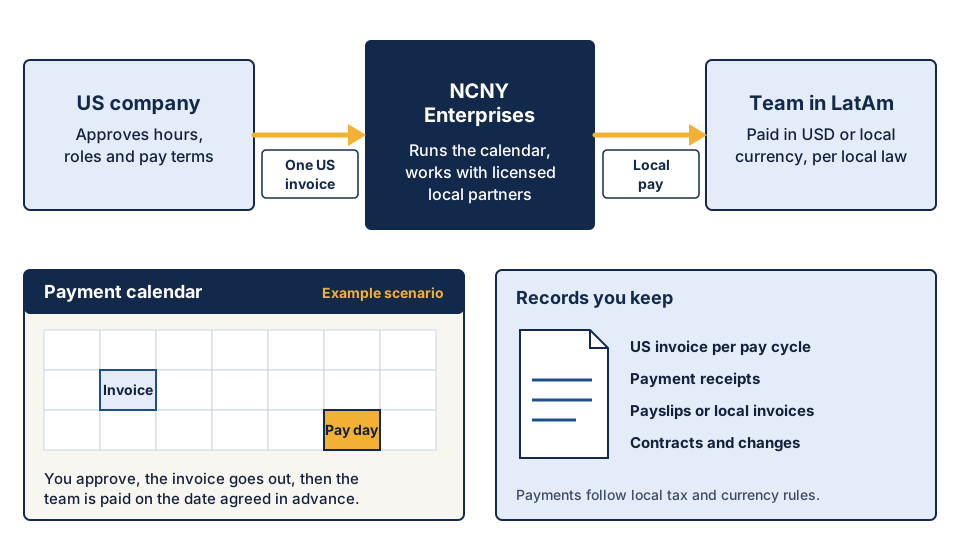
- You receive one US invoice in USD each month for the whole team.
- Your people are paid in USD or in local money, as local law allows.
- A payment calendar fixes the pay date, the invoice date and the cut-off for changes.
- Each payment is recorded, and local payroll reports are shared with you each month.
In some countries, a licensed local partner makes the payment, and in others a bank transfer is enough. Either way, the cost appears on your US invoice. In each case, local payroll is designed to follow the law of that country. Every transfer respects currency rules and tax rules, and each one is recorded for you.
Should Your New Hire Be a Contractor or an Employee?
This is the most important legal question in nearshore hiring. Many firms start nearshore hiring with contractors, because that seems simple. However, if a contractor works like an employee, local courts may treat the job as employment.
That risk is called misclassification, and it can lead to back pay, statutory benefits and fines. For instance, several countries require a 13th-month bonus for employees. Which model fits depends on the role, the country and how the person works.
When Does a Contractor Setup Work Well for a Firm?
A contractor model can fit when the person runs a real business of their own. For example, a freelance designer with several clients, set hours and their own tools may qualify. Even then, the contract is reviewed by a local lawyer or consultant before anyone signs.
When Is a Local Employer of Record the Safer Path?
Where employment is required, an employer of record can hold the local contract. An employer of record is a licensed local firm that employs the person on your behalf. It handles statutory benefits, local tax filings and the employment contract.
Local payroll runs through our licensed partners, such as an employer of record, under local law. Meanwhile, our team handles the hire, the calendar and the records with the partner. Consequently, you get a plain summary of each model before anyone signs.
What Happens in the First Few Months After You Hire?
The first weeks of nearshore hiring set the tone for the whole relationship. First, we agree on a start date that leaves time for the contract and the first pay run. Next, your new nearshore staff receive a welcome note with the pay schedule and their contact person.
Also, during the first month we check in with both sides. Your hiring lead tells us how the nearshore team is doing, and the new hire shares how the set-up feels. Then any gaps in tools, access or hours are fixed early for the nearshore team.
After the first nearshore hiring cycle, you receive the pay reports and a short summary. If something went wrong, such as a late bank transfer, we explain why and what changes. Over time, these checks become lighter as nearshore teams settle in.
Which Roles Do US Firms Often Fill With Nearshore Staff?
Most nearshore hires fall into five groups. Notably, software work is the largest area of nearshore hiring, from web apps to quality testing. Customer support comes next for nearshore teams, often in both English and Spanish.
In addition, accounting roles work well, as long as the person knows US practice. Similarly, design roles suit a nearshore team, because reviews need live feedback. Finally, nearshore staff in sales development call and email leads for your US sales team.
Each group of nearshore staff has its own screen in our nearshore hiring process. For example, a developer takes a coding task, while a support agent does a mock call. Overall, nearshore hiring always starts from a written role brief.
What Might a First Nearshore Hire Look Like for You?
Example scenario: a software firm in Denver wants two remote staff who work Mountain Time. First, we agree on the role brief and the budget in one call. Next, our nearshore recruiting team sources candidates in Colombia and Mexico.
The firm meets four nearshore hires on video and picks two of them. In Colombia, the role is set up as employment through an employer of record partner. In Mexico, a local lawyer or consultant confirms the right contract for the second hire.
From then on, the firm gets one US invoice each month for the nearshore team. Meanwhile, local payroll reaches both developers on the same day. This example is not a client story, but it shows how the parts fit together.
Why Work With a US Partner for Your Team in LatAm?
NCNY Enterprises is a US company, so your nearshore hiring contract and support stay in the USA. Consequently, it is easier for finance and legal teams to approve the project. In addition, you have one contact for recruiting and for pay.
Also, our recruiters and payroll staff speak English and Spanish. As a result, they can talk to your hiring lead and to your new hire with equal ease. In addition, they know which questions to ask a local lawyer or consultant. The NCNY Enterprises home page shows how all three services connect.
Some clients later need visas for staff who move to the USA or Canada. In that case, our visa file team for employers can help. You can also learn how our four team roles share one file.
What Is Included When You Build Your Team With Us?
- A role brief written with your hiring lead.
- Sourcing in the countries that fit the role and the hours.
- An English screen and a skills interview for each candidate.
- A short list of three to five screened people.
- A plain summary of the contractor or employee choice.
- Set-up with an employer of record partner where the law requires one.
- One US invoice and a fixed pay schedule for the whole team.
- Local payroll records each month and a named payroll contact.
Frequently Asked Questions on How We Hire and Pay Your Team
The US invoice covers the pay that reaches your team and our service fee. It may also include the fees of a licensed local partner where one is needed. Each line is shown separately for your finance team. You receive one invoice in US dollars, and the payslips stay available for your records.
It depends on the country and on local law. In some countries, staff can be paid in USD, while others require local money for employees. We explain the options before you hire, and every payment follows the rules of that country. Your invoice stays in US dollars in both cases.
Where a local employer is required, our licensed employer of record partner holds the employment contract under local law. Our team handles the recruiting, the payment calendar and the records, so you deal with one US contact. Local payroll and transfers run through licensed providers in each country. You see the name of that partner in writing before anyone signs.
Sometimes, yes, when the person truly runs their own business. However, if the person works like an employee, local courts may treat the job as employment. We ask a local lawyer or consultant to confirm the model before anyone signs. If an employment contract is needed, a licensed partner runs the local payroll instead.
That depends on the country, the contract model and the bank. Some set-ups are ready within a few weeks, while others take longer. We plan with the real processing times of each bank and partner and keep you updated. We tell you each step and the papers it needs before the start date.
A move to the USA needs a work visa, and the invoice does not change that. Our visa team prepares the file, and a US immigration lawyer or consultant who works with us advises and files. We plan both steps together. The lawyer or consultant confirms which route fits before the employee leaves the local payroll.
What Other Services Could Help Your Team Over the Year?
Students, graduates and professionals from Europe can intern at your firm in the USA or LatAm. We match each role to their studies or experience.
Staff who move to the USA or Canada need a work visa. Lawyers or consultants who work with us advise on and file each case.
Our recruiting and payroll roles work from one client file. See how the team is set up.
Are You Ready to Brief Us on Your First Nearshore Role?
First, tell us the role, the hours and the country you prefer for nearshore hiring. We will reply with a plan for your nearshore hiring and pay.