
Key Takeaway
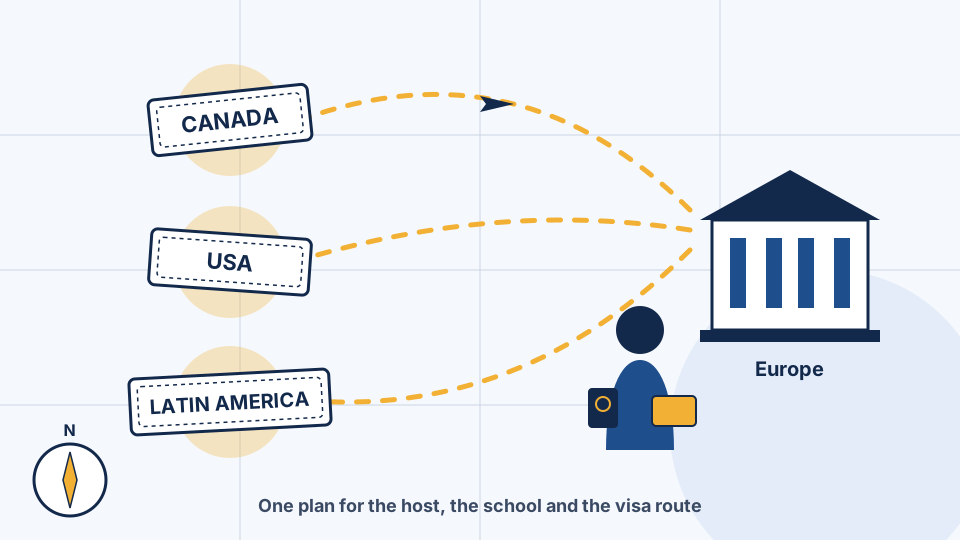
- We run international internships for students, graduates and professionals from Europe in the USA, Canada and Latin America.
- Each work placement is matched to the applicant's studies or experience, and the visa route is planned early.
- We arrange the DS-2019 with a designated J-1 sponsor we work with.
Our international internships connect students, recent graduates and professionals from Europe with host companies in the USA, Canada and LatAm. We also work with career offices, which want each role to count toward a degree and fit each person's goals. First, we search for hosts, match each role to the applicant and agree on clear start dates with both sides. Then we arrange the right visa route for each applicant with sponsors and the lawyers or consultants we work with. Interns at any career stage gain real work abroad, and every school or intern gets one named US contact throughout.
Why Is It So Hard to Find an Intern Job Abroad Alone?
Most people who want international internships hit the same four walls, whether they study or already work. First, few of them know a host company outside Europe. In fact, cold emails to US or Canadian firms often go unanswered for weeks.
Second, the visa route is not obvious. For example, a US internship abroad needs a J-1 visa, which is issued only through a sponsor. Meanwhile, the route to Canada depends on the applicant's country and age.
Third, housing for an internship abroad is hard to judge from far away. Rents, leases and safe areas differ from city to city. Finally, the school needs a signed agreement that sets out goals, hours and supervision.
Each wall can be solved on its own. However, career offices with dozens of candidates, and professionals with full-time jobs, rarely solve all four alone. As a result, many international internships stall before they even start.
Which Routes Lead to a Job in the US, Canada or LatAm?
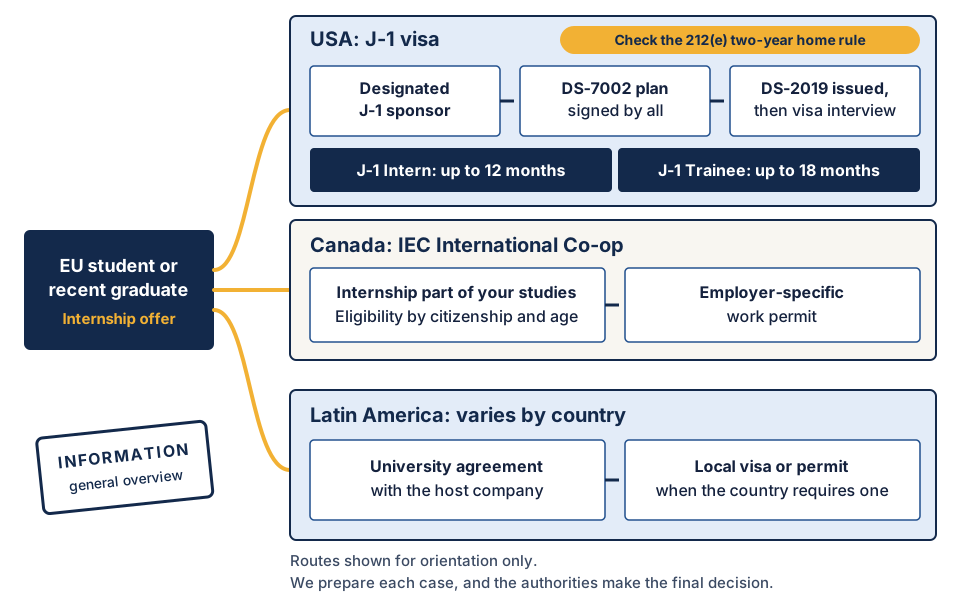
The route for international internships depends on where the host company is based. Below, the usual path in each region is summed up. Note that these notes are general, and a lawyer or consultant who works with us advises on each case.
How Does the US Route Work for an EU Intern?
In the USA, an intern or trainee from abroad needs a J-1 visa, which is issued through a designated sponsor. The sponsor is approved by the State Department and issues the DS-2019 form. Next, the host company and the sponsor sign a training plan, known as the DS-7002.
For US international internships, the J-1 program has two categories. The Intern category lasts up to 12 months, and the work must relate to the field of study. It suits students enrolled at a school outside the US, or graduates within 12 months of the start.
The Trainee category lasts up to 18 months, or 12 in agriculture, hospitality and tourism. It suits graduates with a degree or professional certificate from abroad and one year of related work abroad. Five years of work in the field outside the US also qualifies, so international internships suit mid-career professionals too. Notably, the J-1 rules set no upper age limit, so a trainee may be 25 or 45.
However, a former intern who no longer fits the intern rules must spend two years outside the US first. Only then can that person start a Trainee program with a host company. The rules for US international internships are in 22 CFR 62.22 on eCFR (opens in a new tab). The State Department J-1 intern page (opens in a new tab) sums them up.
Can a J-1 Visa Tie You to Home for Two Years?
Some J-1 visa holders must live in their home country for two years in total after the program. This 212(e) rule does not apply to everyone. It may apply when the US or the home government funded the program, even in part. It may also apply when the field is on the home country's skills list, or for graduate medical training.
Without a waiver, the person cannot get an H-1B, L-1 or K visa, or a green card. That bar lasts until two years at home are done. A change of status inside the US is blocked as well, except to a few rare categories. Notably, the rule may apply even to unpaid international internships, because funding or the skills list triggers it.
An E-2 or O-1 visa may still be possible, but only through a US consulate abroad. Even then, the two years must be met before an H, L or K visa or a green card. The USCIS Policy Manual on the home rule (opens in a new tab) explains this bar. Also, the two years need not be in one block.
A waiver may be requested, for example through a no-objection statement from the home government. Other routes include a US agency request or hardship to a US citizen or green card holder spouse or child. Fear of persecution can also be a route. Still, waivers are decided by the State Department and USCIS, take time and are never certain.
Why Do Interns Fall Into the J-1 Home Rule Trap?
In fact, most people on international internships who get caught did nothing wrong. Instead, they missed an easy signal during the internship search. The common reasons are plain, and career offices see them repeat from year to year.
- The note on the DS-2019 and the visa stamp is only an early view, and it is easy to misread.
- A public grant or scholarship from the home government is forgotten, yet it counts as funding.
- Nobody checks the skills list for the intern's nationality and field of study before the DS-2019 is issued.
- The plan changes later, for example when a host company offers an H-1B or L-1 role.
- Others plan an E-2 startup, join a US partner or seek a green card, then find the rule.
- Many assume they can switch status from inside the US, but the rule blocks that step.
How Do We Plan the J-1 Around Your Later Goals?
This is exactly why international internships in the US must fit the intern's later goals from day one. NCNY Enterprises runs this check for international internships before the DS-2019 is issued, not after. First, we ask each applicant about long-term plans, such as a US job, a startup or a partner. Then we check every funding source for the placement abroad, including grants from the home government.
Next, we check the State Department skills list (opens in a new tab) for the applicant's nationality and field. The 2024 list applies to J status obtained on or after 9 December 2024. We also review the sponsor's early view of the rule before anyone signs.
Based on these checks, we choose a J-1 visa route for international internships that keeps later options open. That may be the intern category, the trainee category or another visa category. If a waiver or later change of status is possible, a lawyer or consultant who works with us advises. Applicants and career offices can raise this on a first planning call with our team.
How Do Young Europeans Get to Canada With the IEC?
Canada runs International Experience Canada, often called the IEC. Many EU countries take part, and the IEC has an International Co-op category for students. That category leads to a work permit tied to one host company. Its Young Professionals category suits graduates who want international internships for career growth.
However, age limits depend on the visa and the country, and each country has its own quota. Thus, eligibility is checked first, before any host company is contacted. The official rules are set out on the IRCC page on International Experience Canada (opens in a new tab).
What Changes When the Host Firm Is Based in LatAm?
In Latin America, the rules vary from country to country. Some roles need a work permit, while others rely on an agreement between the school and the host company. Therefore, we confirm the route with the consulate or a local lawyer or consultant for each placement abroad.
The agreement with the home university matters most of all in this region. Specifically, we make sure it sets out tasks, hours, supervision and insurance. In addition, we check that the host company can sign it in a form the school accepts.
What Do We Do for Your School and Its Career Team?
Career offices tell us what their students study and when international internships fit the year. Next, we turn that brief into a short list of host companies. Overall, our work for schools covers four steps.
- Host search: we contact firms in the target region and check that each role is real and supervised.
- Course match: we compare each role with the field of study, so the credit is not at risk.
- Agreement follow-up: we chase signatures from the host, the school and, in the USA, the sponsor.
- Mid-term check-in: we call the intern and the supervisor halfway through and report back to you.
As a result, your team spends less time on cold emails and puts that time into students. In addition, each school gets one named contact and one shared calendar. Also, reports are written in English, and calls can be held in Spanish or French.
Many career offices run international internships for several faculties at once. In that case, we group students by region and by start date. Thus, one host company can often take two or three students from the same school.
How Do We Help Each Intern Get Ready to Go Abroad?
Students meet us after their school signs up for international internships, while graduates and professionals apply directly. In every case, we treat each applicant as a person, not a file number. Indeed, anyone at any career stage can apply for their internship visa online with us.
- CV and cover letter review in the style that US or Canadian hosts expect.
- Interview practice by video, with plain notes on what to improve.
- Matching with host companies based on skills, language level and the field of study.
- A pre-departure checklist for visa papers, insurance, money and travel.
- Housing pointers for each city, such as areas to look at and leases to avoid.
The host and the consulate make the final decision, and we prepare each applicant to make the strongest possible case. Still, a well prepared applicant makes a far better first impression. Moreover, the intern always knows who to call if a plan changes.
What Does a Typical Placement Look Like From Start to End?
Example scenario: a business school in Spain wants summer roles for eight students. First, the career office sends us the course list and the dates. Next, we pick the regions that fit each field of study and each budget.
Within the first weeks, we share a list of international internships at host companies in Miami, Montreal and Mexico City. Then each student is interviewed by video, and each host company chooses its intern. For the US roles, the host company and a sponsor complete the J-1 visa training plan together.
For the Canadian roles, we check IEC eligibility and help each student gather the papers. Meanwhile, the host in Mexico signs an agreement in the form the school accepts. Finally, each student gets a pre-departure call and a city sheet with housing pointers.
This example is not a client story, and real timelines are often different. Still, it shows how international internships move when one team holds every thread.
Which Fields of Study Do We Place Most of Our Interns In?
We focus our international internships on fields where host companies in the Americas often take interns. These include marketing, business, engineering and hospitality. In addition, we place interns in health administration and in design.
Each field of study has its own rhythm. For example, hotels often hire for the summer, while tech firms may start at any time. Likewise, design studios tend to ask for a portfolio before the first call.
If your field is not listed, ask us anyway, since a host company may still say yes. In many cases, we can still find a host if the role fits the field of study. Either way, we report plainly on how the search is going at each stage.
What Should You Know About Pay, Dates and the Rules?
Pay for international internships follows the rules of the host country and the visa type. Some roles are paid, and some are unpaid. Notably, in the USA both types still need the J-1 visa.
Also, dates matter just as much as pay. Indeed, sponsors, consulates and permit offices each take their own time. For that reason, we suggest that applicants and career offices start the internship search several months before the planned start.
Importantly, our service covers the legal advice and the visa forms as well. In fact, our sponsor partners and the lawyers or consultants who work with us handle those steps with our team. You can see how that works for staff on our work visa support page.
Why Do Interns and Schools Pick a Partner Based in the US?
NCNY Enterprises can speak to US hosts on their own terms. Our contracts follow US practice, and our team keeps US business hours. As a result, a host company replies faster and agreements move with less friction.
At the same time, our team speaks the languages of Europe and Latin America, which career offices value. That helps when a host in Mexico or Quebec needs to talk to a school in Spain. Overall, international internships run better when one firm can speak to every side.
Some interns later return as full hires after international internships end. In that case, our nearshore hiring and payroll team takes over. You can also read about the roles on our team.
What Is Included When You or Your School Work With Us?
- A kick-off call with you or your career office to set goals and dates.
- A search for international internships in the USA, Canada or Latin America.
- Role checks against the field of study and credit rules.
- Help with the J-1 visa training plan, which is signed by the host company and sponsor.
- An eligibility check for the IEC Co-op route in Canada.
- CV review and interview practice for each applicant.
- A pre-departure checklist and housing pointers.
- A mid-term check-in and a short end-of-term report.
Frequently Asked Questions on How We Place an Intern Abroad
We arrange the DS-2019 with a State Department designated sponsor we work with, as part of our service. First, our team finds the host, prepares the documents and drafts the training plan with the host. Then the sponsor reviews the plan and issues the DS-2019 form. Meanwhile, we keep you, any school involved and the host on schedule.
Career offices usually start with a short call about courses, dates and preferred regions. Then we send a written plan with the steps, the timeline and the people involved. Once you agree, we begin the host search and keep you updated at each stage. A named contact on our side answers your questions from the first call to the end.
Yes, in the USA the J-1 Intern category requires work related to the intern's field of study. Schools also need the role to fit the course so the credit counts. We check each role against the course goals and keep searching when a role does not fit. The sponsor then reviews the training plan before it accepts the role.
Yes, students, recent graduates and professionals of any age can apply to us directly. The J-1 Intern route needs proof of enrollment or a degree from the last 12 months. The J-1 Trainee route needs a degree and a year of related work, or five years in the field. Other countries set their own rules, and age limits depend on the visa.
Yes, paid and unpaid roles both need the J-1 visa in the USA, and the host decides whether a role is paid. In Canada and Latin America, pay rules depend on the country and the permit type. We explain the options, and an immigration lawyer or consultant who works with us confirms the legal points. In the USA, the sponsor also reviews the training plan for every role.
Start as early as you can, ideally several months before the planned start. Narrow fields have fewer hosts, so the search can take longer, and sponsors and consulates set their own pace. We plan with the real processing times of each office and keep you updated. Indeed, an early start gives every applicant a fair chance.
Not always, since the two-year home rule applies only in some cases. It may apply if the US or your home government funded your program, even in part, or if your field is on your country's skills list. If it applies and is not waived, you must live at home for two years in total before an H-1B, L-1 or K visa or a green card. Many interns miss a note on the DS-2019, so we check funding, the skills list and your later plans before the form is issued.
Sometimes, but it depends on the two-year home rule. If 212(e) applies and is not met or waived, an H-1B, L-1 or K visa or a green card must wait, and you cannot change status from J-1 inside the US. An E-2 or O-1 may still be possible through a US consulate abroad. For that reason, we plan the J-1 with your later goals in mind from day one, with a lawyer or consultant who works with us advising on each change.
What Other Services Might Help Your School or Team Next?
Some interns return as full hires in Latin America. Our team can then hire and pay them under local rules.
Employers who move staff across borders need clean visa files. Lawyers or consultants who work with us then advise on and file each case.
Our four roles share one client file and one US contact. Read who does what before you call.
Ready to Plan Your Own Internship or Your School's Interns?
Specifically, applicants can start the internship search online today, and schools can share fields, dates and regions. We will reply with a first plan for your international internships.