
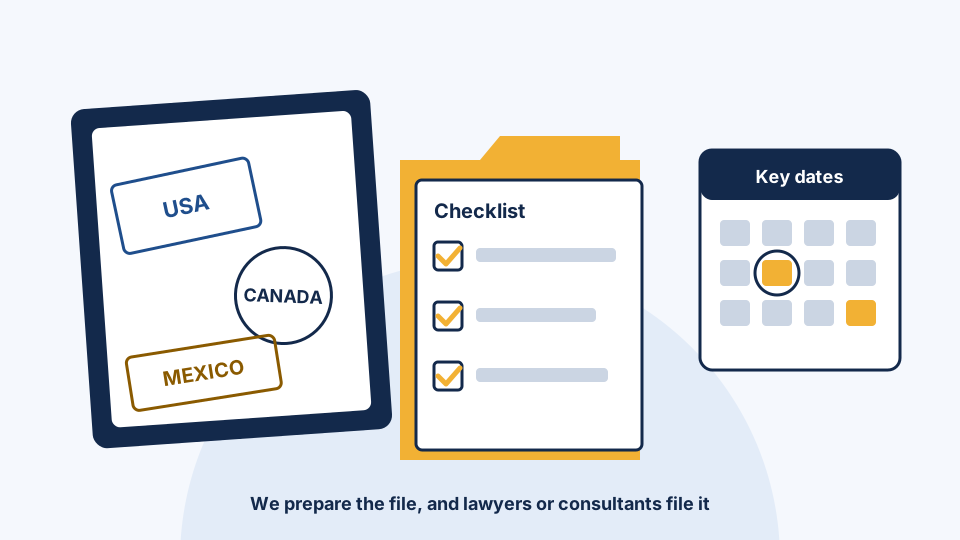
Key Takeaway
- Our work visa support serves employers in the USA, Canada, Mexico and Latin America.
- Immigration lawyers or consultants who work with us advise on and file each case.
- Authorities decide each case, and we build each file to be as strong as it can be.
Our work visa support helps employers in the USA, Canada, Mexico and Latin America move their own staff across borders. First, we look at the role, the person and the countries involved, and then we map the likely visa routes. Then we gather each document, track each date and keep the employee informed at every single step of the way. An immigration lawyer or consultant who works with us then advises on and files each case, within one complete service. You get one organized file and one US contact, while lawyers or consultants on your file handle each legal decision.
Why Do Work Visas Take So Much Time and Effort for Firms?
Employers ask for work visa support for three main reasons. First, each country has many categories, and each one has its own tests. For example, a manager, an engineer and a trainee may each need a different route.
Second, the paperwork for staff visas is heavy. Degrees, job letters and civil records often need translation and legal stamps from the country that issued them. In addition, one missing page can send a case back to the start.
Third, dates pile up fast, since forms have filing windows and documents expire. Consulates also set their own calendars. Meanwhile, the employee is waiting to start the job and to plan a move for the family.
Most HR teams handle these cases only a few times a year. As a result, a routine is rarely built for them. Our work visa support gives you that routine without a large in-house team.
What Do We Do to Prepare Each Case for Your Staff?
Our work visa support covers the whole case, from the first review to the filing. Specifically, seven tasks are included for each case.
- Needs review: we learn the role, the dates and the person's history, then list the likely routes.
- Document checklist: each case gets a list of papers that fits the route and the country.
- Translation and legal stamps: we arrange certified translations and an apostille where needed.
- Timeline tracking: every deadline, renewal and expiry date is placed on a shared calendar.
- Appointment prep: we help the employee book and prepare for the consular appointment.
- Relocation basics: we share pointers on housing, banking and first-week tasks.
- Filing: the lawyers or consultants who work with us sign and file the case.
As a result, the lawyers or consultants who work with us use a complete, well ordered file. That saves time on their side and lowers the risk of a request for new evidence. Overall, our work visa support joins careful order with sound legal judgment.
Who Gives the Legal Advice, and Who Files Each Case?
Our work visa support includes the legal advice and the filing of each case. Our team prepares the file, and the lawyers or consultants who work with us advise on it and file it. The rules on who may sign are strict, and they are followed closely.
In the USA, lawyers or consultants give immigration advice for a fee. USCIS explains this on its page on finding legal services (opens in a new tab). Thus, an immigration lawyer or consultant who works with us advises your company and files each US case.
In Canada, paid advice comes from a lawyer or consultant. Consultants in Canada are registered with the College of Immigration and Citizenship Consultants (opens in a new tab). Similarly, in Mexico and across Latin America, local lawyers or consultants who work with us handle legal steps.
Your plan names the lawyers or consultants for each case before work visa support begins. You can read how this works in our terms on legal advice and filing.
Which Visa Routes Are Common in Each Country We Serve?
The notes below give a general view of each route. In fact, the right route always depends on the person, the role and the dates. That call is made by an immigration lawyer or consultant for each case.
Which US Visa Types Come Up Most Often for Staff?
US employers often ask about the H-1B for specialty roles and the L-1 for transfers within one company. Also, the O-1 is used for people with extraordinary ability. For citizens of Canada and Mexico, the TN status may fit certain professions.
In addition, the J-1 visa covers interns and trainees through designated sponsors. Each of these categories has its own tests and its own forms. Therefore, the lawyer or consultant decides which one fits before anything is filed.
Why Check a Past J-1 Intern Before You Hire Them?
Some firms host J-1 interns or trainees and later want to hire them. Before you sponsor a former J-1 intern or trainee for an H-1B or L-1, check whether 212(e) applies. If it does, the two-year home rule must be met or waived first. Immigration lawyers or consultants who work with us advise on waivers, which agencies decide case by case.
While the rule applies, the person also cannot change status from J-1 inside the US. An E-2 or O-1 visa may still be possible, but only through a US consulate abroad. Even so, the two years at home still count before a later H-1B, L-1 or green card. As a result, a hire that looked simple can take far longer than planned.
The USCIS Policy Manual on the J-1 home rule (opens in a new tab) explains the change of status bar. For that reason, our work visa support aligns the J-1 with the later visa plan from the start. When a company hosts interns it may hire later, we raise this before the DS-2019 is issued. We ask about funding, the skills list and the hiring plan, then share the facts with the sponsor.
Also, an immigration lawyer or consultant reviews each later step, and we add this check to the document checklist. In fact, early work visa support can save months when the hire comes.
What Routes Do Staff Use to Work in Canada Today?
Most foreign workers in Canada need an employer-specific work permit. Some of these permits need a labour market test, and others are exempt under trade or exchange rules. For young people from partner countries, International Experience Canada may also apply.
A Canadian lawyer or consultant who works with us confirms the route. Meanwhile, we prepare the employer letters and the document checklist that the route needs.
What Does a Move to Mexico Need for a New Hire?
Mexico usually grants temporary residence with permission to work, and that permit is issued in steps. The process often starts at a Mexican consulate abroad and finishes with the immigration office in Mexico. A local lawyer or consultant confirms each step, and we add the papers to the document checklist.
What If the Move Is to Another Country in LatAm?
Each country in Latin America sets its own rules, so work visa support must adapt. Some issue a visa at a consulate first, while others process the permit after arrival. For that reason, we work with local lawyers or consultants in the country of destination for every case.
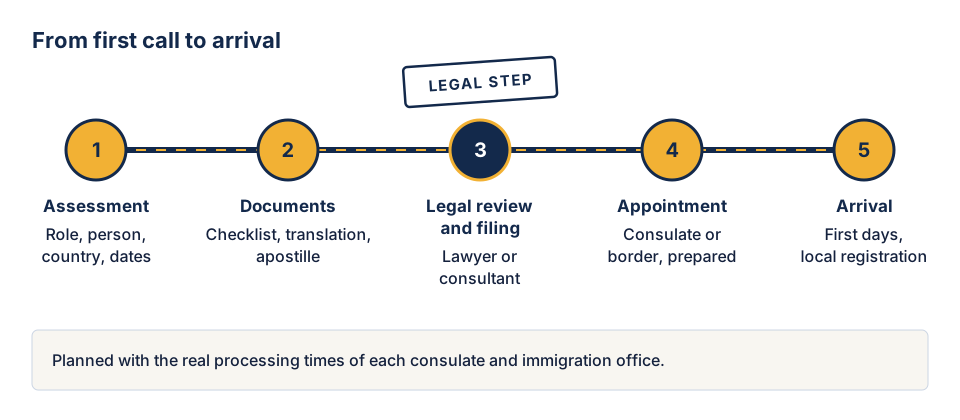
How Do We Keep the Papers and Dates in Order for You?
Every case starts with a document checklist built for that route. The list names each paper, who provides it and whether it needs a translation or an apostille. Also, each item gets a due date that works back from the filing window.
Next, the papers are stored in a shared folder with clear names. Then we check each one against the list before it goes to the lawyer or consultant. For example, we look for missing pages, wrong names and expired passports.
Before the consular appointment, our work visa support team runs a short prep call with the employee. We go over the papers to bring, the questions to expect and the logistics of the day. Afterwards, the calendar is updated with any new dates set after the consular appointment.
How Can HR Teams Plan Ahead Before the Next Staff Move?
The best work visa support starts long before a case is filed by lawyers or consultants. In many firms, the first sign of a move is a manager who says someone must start abroad next month. By then, the options are often narrow.
Instead, we suggest a short planning call each quarter. During that call, we look at the moves your teams expect over the next year. Then each move is placed on a calendar with the steps it will likely need.
This approach helps in three ways. First, each document checklist can be started early, so degrees and records arrive in time. Second, lawyers or consultants can review the options before the deadline is close. Third, the employee has time to plan the consular appointment and the family move.
Similarly, planning ahead helps with budgets. Because each step is known early, finance can set aside the cost of translations, fees and travel. Overall, work visa support turns a rush into a routine that HR can manage each year.
What Could a Typical Case Look Like From Our Side?
Example scenario: a firm in Monterrey wants to move a project lead to its office in Austin. First, we review the role and the person's history in one call. Next, the US immigration lawyer or consultant chosen by the firm reviews the options.
Once the lawyer or consultant picks a route, we build the document checklist and order the translations. Then the lawyer or consultant prepares and files the case. Meanwhile, we track each date and keep the project lead informed.
When the case reaches the consular appointment, we hold a prep call with the lead. Finally, we share relocation pointers for the first weeks in Texas. This example is not a client story, and real outcomes always depend on the authorities.
Why Do Employers Use a US Partner for These Cases?
NCNY Enterprises is a US company with staff who speak English, Spanish and French. Consequently, we can talk to a recruiter in Toronto and a lawyer or consultant in Miami on the same day.
We also know the other parts of a move beyond work visa support. For instance, a hire may start as a nearshore employee and later move to the USA. In that case, our nearshore payroll team for LatAm works on the same file. Likewise, interns from Europe may follow our J-1 internship routes.
Finally, the authorities make the final decision, and we prepare each file to give it the strongest possible basis. Our work visa support offers order, speed and plain words up to the consular appointment.
What Is Included in Our Support for Each Visa Case?
- A needs review for each employee and role.
- A document checklist built for the chosen route.
- Coordination of certified translations and apostilles.
- A shared calendar with every deadline and expiry date.
- Filing of each case by the lawyers or consultants who work with us.
- A prep call before each consular appointment, in the right language.
- Relocation pointers for the first weeks.
- One US contact who answers in English, Spanish or French.
Frequently Asked Questions on How We Help With a Work Visa
Yes, every visa file includes a lawyer or consultant as part of our service. Our team prepares the whole file, from the needs review to the last translation. Then a US or Canadian immigration lawyer or consultant who works with us gives the legal advice. That same lawyer or consultant signs the forms and files the case, so each legal role is clear.
We prepare every file to give it the strongest possible basis. Each paper is checked against the document list, and each date is tracked. Then the immigration lawyer or consultant reviews the full case before it is filed. The consulate or immigration office makes the final decision on the visa stamp, and we keep you updated.
It depends on the route and the country. A typical list includes a passport copy, degrees, job letters and civil records. Some papers need a certified translation or an apostille, and the list notes which ones. We send the list in writing and mark each paper as received once we have it.
Yes, we run a short prep call before each consular appointment. We go over the papers to bring, the questions to expect and the logistics of the day. We also remind each person to answer truthfully and in their own words. The slot itself is booked with the consulate, and we tell you as soon as one opens.
That depends on the consulate, the season and the visa type, and it can change quickly. So we plan with the real processing times of each consulate and keep you updated. Also, we check the published calendar often and tell you as soon as a slot opens. The start date is then planned with you, so the role never hangs on one slot.
Yes, your company can choose its own lawyer or consultant. In that case, we work with them and follow their instructions. If you have none, an immigration lawyer or consultant who works with us takes the case as part of our service. Either way, we keep the document checklist and the calendar for the whole file.
What Other Services Fit Well With Your Visa Plans Today?
Hire people in Latin America who work your hours, and pay them under local law each month.
Host an intern from a European school, with the J-1 or IEC route planned from day one.
See which team role handles your visa file, and how we check our facts.
Do You Have a Staff Move Coming Up in the Next Months?
First, tell us who is moving, from where and to where. We will reply with a first plan for your work visa support.